The Difference Between a Lyric and a Poem
At SongBay, we regularly receive writing that is labelled as a lyric, although it is really a poem, a prose passage, a collection of thoughts or a sequence of stanzas that has not yet been shaped for music.
That does not mean the writing lacks value. A poem may contain a striking image, a memorable phrase or an emotionally powerful idea. It may be the beginning of an excellent lyric. The important point is that a poem does not become a lyric simply because its author calls it one.
There is another common confusion worth clearing up. Words alone are not normally a finished song. They are the lyric. A song is the complete musical work: words, melody, rhythm, harmony, form and performance working together. Lyricists should be proud of their contribution, but accurate language makes collaboration easier. Saying “I have written a lyric and I am looking for a composer” tells a musician exactly what exists and what is still needed.

A poem controls its own pace; a lyric shares time with music
A reader can pause over a poem, reread a difficult line or decide how quickly to move through it. A singer has no such freedom. The lyric must travel through a fixed number of beats, at a chosen tempo, inside a melody, while leaving enough breath and space for expression.
This is the central difference:
A poem is complete as language on the page. A lyric is language designed to become part of music.
That design requirement changes almost everything. It affects line length, syllable placement, repetition, rhyme, vocabulary, section order, emotional pacing and even the sounds of individual consonants and vowels.
A poem can ignore normal song structure. It can grow longer, become shorter, wander into a new idea or end without returning to an earlier one. A lyric can do those things too, but every choice has to work when somebody sings it. The question is no longer only, “Does this read well?” It becomes, “Can somebody sing it naturally? Can a listener remember it? Is there room for the music?”
The three stages writers often confuse
It helps to separate three different creative stages:
- The initial idea: notes, images, phrases, memories or emotional fragments.
- The lyric: words intentionally organised for musical setting and vocal performance.
- The song: the finished union of lyric, melody, rhythm, harmony, arrangement and performance.
There is no shame in being at stage one. Every strong song begins with unfinished material. Problems arise only when raw material is treated as finished craft. Calling a page of spontaneous thoughts “a song” can prevent the editing and collaboration that might turn those thoughts into one.
Structure gives the listener a map
Most listeners never see the lyric sheet. They hear the song as it moves past them. A clear structure helps them follow it and recognise what matters.
A familiar contemporary form might be:
Verse 1 → Pre-chorus → Chorus → Verse 2 → Pre-chorus → Chorus → Bridge → Final chorus
This is not the only valid structure. Folk narratives, hip-hop, musical theatre, progressive music and through-composed works may follow very different designs. Even so, every effective lyric needs an intelligible shape.
Ask these questions:
- What changes between the first and second verse?
- Which section carries the central message?
- What does the listener need to remember after one hearing?
- Does each return of the chorus feel earned?
- Does the bridge reveal a new angle, raise the stakes or create contrast?
- Could any section be removed without weakening the song?
If the lyric contains twelve verses saying roughly the same thing, the answer is rarely to add more music. It is usually to edit.
Making words look tidy is not arranging a song
Another common misunderstanding happens when a writer carefully spaces the words on the page, centres the title, separates a few blocks of text and assumes that the song has now been arranged.
It may look lovely. It may even deserve an attractive font. But that is page layout, not musical arrangement.
In songwriting, structure tells us what each section is doing. Arrangement tells us how the complete song develops through instruments, voices, dynamics, texture, rhythm, register and space. Blank lines between paragraphs do not tell a composer whether a section is a verse, chorus, pre-chorus or bridge. They do not show where the music should grow, where it should become quieter, where a hook should return or where the singer needs room to breathe.
A useful lyric sheet should label its sections clearly:
- Verse 1
- Pre-chorus
- Chorus
- Verse 2
- Bridge
- Final chorus
Those labels are not the arrangement itself, but they give the composer a practical map. They show that the writer has thought about how the words might behave as part of a song.
And then there is the occasional twelve-verse epic. If every verse introduces an essential new part of a remarkable story, perhaps the lyric belongs to a folk ballad, musical or another long-form style. If all twelve verses repeat the same feeling in slightly different words, the listener may feel as though the song has taken up permanent residence.
Most three-minute pop songs do not need ten or twelve verses. They need selection. Choose the strongest details, let each verse move the story forward and trust the chorus to carry the central idea. The lines you remove are not wasted. They may contain the beginning of your next lyric.
Leave room for musical framing
At SongBay, we describe this as musical framing. It means leaving deliberate space around and between the words so the music can introduce, answer, connect and complete them.
Think about the parts of a song where nobody needs to sing:
- the introduction that establishes the mood;
- a short instrumental answer after a vocal line;
- a turnaround at the end of a verse;
- a pause before the chorus arrives;
- a musical link between two sections;
- an instrumental break or solo;
- a held chord, breath or moment of silence;
- an outro that allows the final idea to settle.
These moments do not take time away from the lyric. They frame it. They give the listener time to absorb an important line, and they allow the instruments to reply in ways that words cannot.
A page packed from top to bottom with continuous language leaves the composer with a difficult choice: rush the words, make the song unusually long or remove part of the lyric. A good lyricist starts thinking about musical space before the arrangement is built.
Mark possible spaces directly on the draft. Simple notes such as two-bar introduction, instrumental answer, pause, four-bar link or outro can help the writer hear the future song. These notes are suggestions rather than commands. The composer may find a better solution, but the exercise proves that the lyricist is thinking in musical time rather than page space.
Try reading the lyric with a stopwatch. Include a realistic introduction, brief links between sections and a short ending. If the words already occupy the full target duration, the finished song has nowhere to breathe.
Musical framing does more than break the lyric up. It breaks the lyric open, giving the melody, arrangement and performance room to make the words more powerful.
Find the emotional centre, then build the chorus around it
The chorus is often the lyric’s focal point. It usually contains the clearest expression of the song’s central idea, title or emotional conclusion.
Try completing this sentence:
“This song is really about…”
Write the answer in one plain sentence. Then ask whether the chorus communicates that idea more clearly and memorably than any other section. If a powerful line is hiding in verse four, it may actually belong in the chorus.
A useful chorus often does at least two of the following:
- states or reframes the main idea;
- contains the title or hook;
- uses stronger repetition than the verses;
- opens melodically or emotionally;
- simplifies the language after denser narrative detail;
- gives the listener a phrase they can anticipate and sing back.
Repetition is not laziness when it creates recognition, emphasis and emotional release. Repetition without development, however, can feel static.
Symmetry is not sameness
Composers need a workable relationship between corresponding sections. If verse one has four lines and verse two has eleven, or if matching lines vary wildly in syllable count, the same melody may no longer fit.
As a starting discipline, compare equivalent sections:
| Element | Verse 1 | Verse 2 | Question |
|---|---|---|---|
| Lines | 4 | 4 | Do the sections occupy similar musical space? |
| Syllables in line 1 | 8 | 8 | Can the same melodic phrase fit naturally? |
| Stresses | STRONG weak STRONG weak |
STRONG weak STRONG weak |
Do important words land in comparable places? |
| Rhyme pattern | ABAB | ABAB | Is the listener given a recognisable pattern? |
The figures do not have to match mechanically. A one-syllable variation can sound entirely natural, while two lines with the same syllable count can feel awkward if their stresses fall differently. The goal is functional balance, not arithmetic perfection.
Songwriters sometimes call this relationship between words and music prosody. Put simply, good prosody means that the rhythm, melody and performance support what the words naturally mean.
Consider the phrase “I never said I loved you.” Its meaning can change depending on which word receives the strongest musical stress. A lyricist should know which word matters and create space for the composer and singer to emphasise it.
Count stresses as well as syllables
Syllable counting is useful, but it is only the first check.
Say each line aloud and underline the naturally stressed syllables. Then compare it with the corresponding line in the next verse. If the stress pattern changes dramatically, a shared melody may force the singer to distort a word or emphasise an unimportant syllable.
For example:
I LEFT my COAT out IN the RAIN
has a clear sequence of natural accents. A replacement line with a similar number of syllables but different stress placement may not sit comfortably on the same melody.
Listen to the vowel sounds too. Long melodic notes are normally easier on open, comfortable vowels. A group of hard consonants can add exciting rhythm, but it may become difficult to sing on a high note or at a fast tempo.
Test the lyric against tempo and metre
A lyric does not exist outside time. At 70 BPM, a singer may have room to stretch vowels and leave silence between phrases. At 130 BPM, the same words may require a very different delivery. Faster does not always mean more words; sometimes it means shorter, sharper phrases.
Time signature matters too. A straight four-beat feel encourages different phrases from the rolling feel of 6/8. A line that feels awkward in 4/4 may flow naturally in 6/8, or the other way around.
Try this practical test:
- Set a metronome to a comfortable tempo, perhaps 80 BPM.
- Count four beats repeatedly: 1, 2, 3, 4.
- Speak the verse in time, without rushing small words or swallowing syllables.
- Mark the words that naturally land on strong beats.
- Repeat the exercise at 65 BPM and 110 BPM.
- Try counting 1, 2, 3, 4, 5, 6 with the feel grouped as ONE two three FOUR five six.
This is not a substitute for melody, but it quickly reveals overcrowded lines, inconsistent phrasing and accidental tongue-twisters.
Record the exercise on a phone. Listening back is often more revealing than reading from the page.
How many words should a lyric contain?
There is no universal maximum. Genre, tempo, duration, repetition and vocal style all matter. Rap can carry far more language than a slow ballad. A narrative folk song may need several verses. Musical theatre may advance a complex scene. Minimal pop can build an entire song around a handful of phrases.
Research also shows why simple internet rules can mislead. One large study of 2,175 well-known English-language songs found an average of about 312 sung words per song. Another collection of chart songs found an average of about 435. These totals normally count a chorus, hook or backing-vocal phrase every time it is heard.
That is not the same as submitting 400 or 700 mostly unrepeated words on a page.
As a practical guide, many conventional three-minute pop songs contain around 180 to 300 sung words, with plenty falling somewhere in the low 200s. This is not a fixed rule. Tempo, genre, repetition and vocal style all make a difference. A slow ballad may need far fewer words, while rap and other rhythmically dense styles may use considerably more.
Most conventional pop songs use two or three verses, and many modern releases use only two. A common shape is verse, chorus, second verse, chorus, bridge and final chorus. A third verse can work beautifully when it adds a real development, a new scene or a change in the story. It should not be included simply because the writer believes every song is supposed to have one.
The useful question is not, “Have I reached three verses?” It is, “Has every verse earned its place?” Two strong verses will usually serve a song better than three strong verses followed by a fourth that merely restates them.
The lyric on the page may contain far fewer different words because the chorus and hook come back several times. A 400-word draft needs careful editing. A 700-word draft will usually be far too crowded for a conventional pop song unless the style, tempo and performance clearly call for that amount of language. At an ordinary pop tempo, the singer should not need the lung capacity of a pearl diver or the delivery speed of an auctioneer simply to reach the second chorus.
Instead of asking only, “How many words have I written?”, ask:
- How long will these words take to sing naturally?
- How many are repeated because they form a hook?
- How many introduce genuinely new information?
- Is there room for melody, breath, instrumental movement and emotional emphasis?
- Does the genre support this lyrical density?
The problem is not a large number by itself. The problem is language that leaves no room for music.
Turn explanation into imagery
Poems and lyrics both benefit from imagery, but songs have limited time. A concrete image can do the work of several explanatory sentences.
Instead of writing a paragraph explaining loneliness, choose an observable detail: a second cup left untouched, a hallway light still burning, or a name removed from a shared door. The image allows the listener to feel the situation rather than receive a report about it.
Useful devices include:
- metaphor, which carries meaning through comparison;
- personification, which gives human behaviour to an object or idea;
- alliteration and assonance, which create patterns of consonants and vowels;
- onomatopoeia, which uses words whose sound contributes to their meaning;
- internal rhyme, which can create momentum within a line;
- contrast, which places opposing images or emotions beside one another.
Use these techniques to help the song. A clever phrase is not automatically a good lyric if it distracts from the feeling or the story.
Write for the voice, not only for the eye
A line can look elegant and still be difficult to sing. Read every draft aloud. Then sing or chant it on one or two notes, even if you do not consider yourself a singer.
Listen for:
- breaths that arrive in the middle of an important thought;
- ordinary words receiving unnatural emphasis;
- too many consonants packed into a fast phrase;
- filler words added only to complete a rhyme;
- abstract language with no image or action;
- lines that explain what the previous line already showed;
- rhymes that make the next idea predictable;
- verse endings that fail to lead toward the chorus.
If a line cannot be spoken comfortably in rhythm, it is unlikely to become easier when pitch, breath and performance are added.
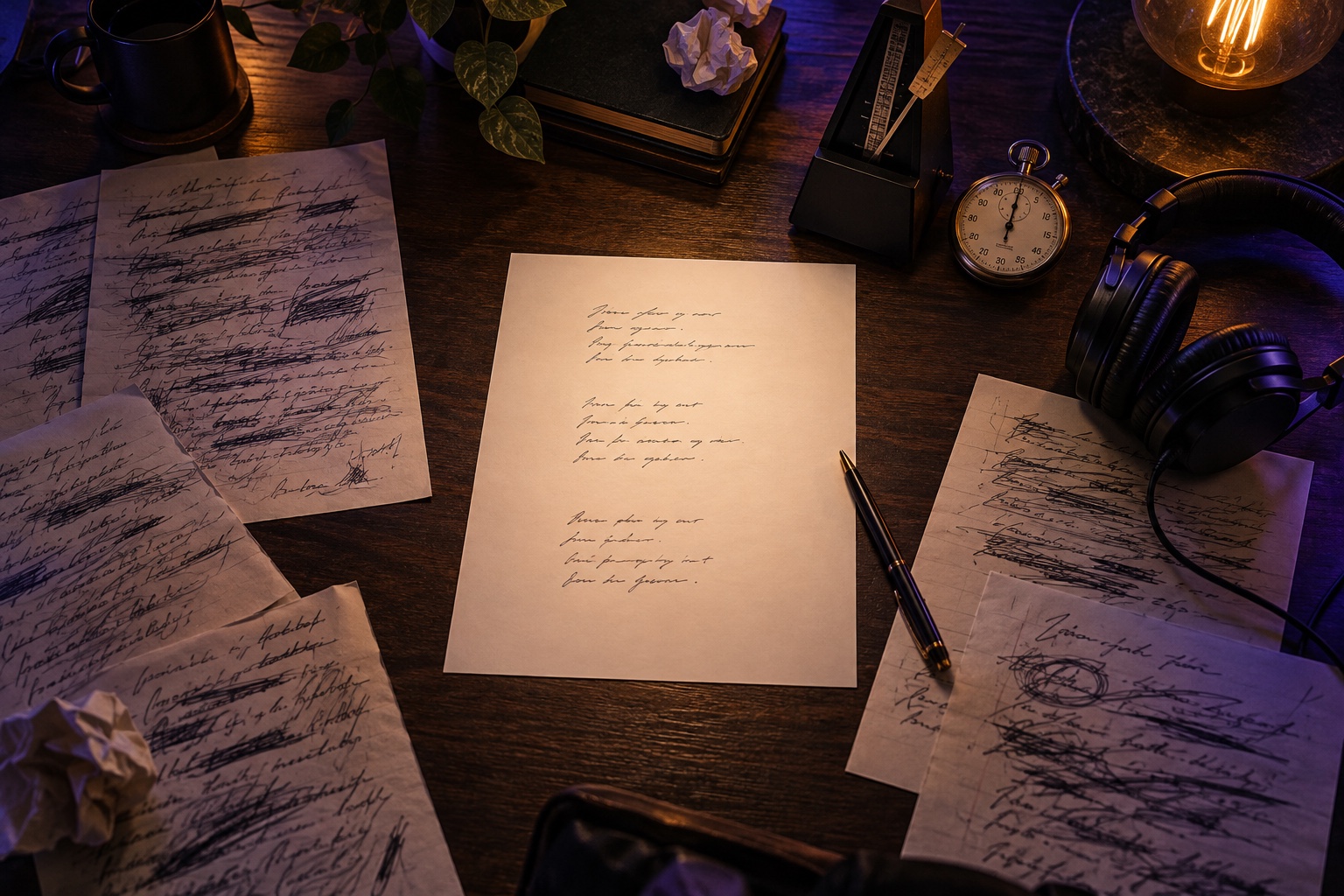
A practical poem-to-lyric editing method
Start with the original poem or free-written text, then work through these stages:
Think of this process as lyric filtration. At the beginning, capture everything. Write down the images, memories, phrases, rhymes and feelings while they are fresh. Then pass that raw material through a series of filters:
- Does it support the song’s central idea?
- Does it add something new?
- Can it be sung naturally?
- Does it fit the structure and timing?
- Is it stronger than the other lines competing for the same space?
- Does it leave room for musical framing?
The aim is not to make the lyric smaller simply for the sake of it. The aim is to concentrate it. Just as a producer may remove unnecessary parts so the strongest instrument can be heard, a lyricist removes weaker language so the best words carry more weight.
Keep everything you filter out in a separate ideas file. A discarded verse may contain a title, image or opening line for another song. Editing is not throwing ideas away. It is choosing which song each idea truly belongs to.
1. Circle the strongest line
Choose the line with the clearest emotional charge or most memorable language. Test it as a title or chorus hook.
2. Write the song’s purpose in one sentence
Decide what the listener should understand or feel by the end. Remove passages that belong to a different song.
3. Sort the material by function
Use verses for scene, detail and development. Use the chorus for the central idea. Use a bridge only if it adds a genuinely new perspective or change.
4. Build matching section shapes
Give corresponding verses a comparable number of lines, syllables and natural stresses. Keep enough flexibility for human phrasing.
5. Choose a provisional tempo and metre
Speak the lyric with a metronome. Test whether the density suits the emotional character and likely genre.
6. Cut before adding
Remove repeated explanations, weak adjectives, unnecessary backstory and lines included only to preserve a rhyme. Protect the strongest images.
7. Create contrast
Let verses and choruses differ in perspective, sentence length, lyrical density or emotional intensity. A chorus should feel like an arrival, not another verse with a new label.
8. Leave space for the composer
Do not fill every beat with language. Instrumental answers, held notes, breaths and silence are part of songwriting.
9. Make a rough performance
Speak, chant or sing the draft. Record it. Revise what the ear rejects, even if the eye still likes it.
10. Invite informed collaboration
A composer may hear rhythms, repetitions or structural ideas that are hard to spot on the page. Good collaboration begins when both people understand that the lyric and the music may need to change for each other.
A lyric is not a lesser poem
Editing a poem into a lyric is not a process of making the language simpler or less intelligent. It is a change of medium.
The lyric gains melody, harmony, groove, repetition, vocal expression, changes in volume, silence and arrangement. In return, it must leave room for all of them.
The strongest lyricists do not merely place attractive words into verses. They hear the future song inside the language. They understand where a singer will breathe, where a listener will anticipate the hook, where a melody needs an open vowel, and where one precise image can replace an entire paragraph.
Before calling a piece a finished lyric, ask one final question:
Have I written words that describe an idea, or have I shaped language that is ready to live inside music?
That question is not intended to discourage writers. It is an invitation to practise the craft that turns a promising page into a compelling song.
Protect the human lyric when working with AI music
AI music tools can now turn a written lyric or creative brief into a detailed musical production, sometimes including melody, instruments and vocals. That can be an exciting way to explore an idea, but it also makes accurate authorship records more important.
The legal position of AI-generated material is not the same everywhere, and AI music is not automatically public domain. Copyright may depend on the country, the amount of human creative input, the way the material was made and the terms of the service used. A writer should always read those terms before uploading original work.
The human-written lyric remains a separate and valuable contribution. Before combining it with AI-generated music, keep a clear record of the lyric itself, its drafts, the date of creation and the decisions that shaped it. This can help distinguish the writer’s original words from the AI-assisted production around them.
AuthentiTrack by SongBay is designed to help writers document that creative journey. It can preserve a structured record of the lyric and the writer’s creative decisions, providing useful supporting evidence of what existed at a particular point in time. This may be valuable if authorship or permitted use is later questioned.
No record can physically prevent somebody from copying a lyric, and AuthentiTrack is not a replacement for legal advice or an official copyright registration where one is available or appropriate. Its strength is that it helps the writer build a clearer authorship trail before the work moves into collaboration, AI production or wider circulation.
That distinction matters. Even when the copyright position of an AI-generated musical element is uncertain or different across countries, the writer should be able to identify and support the human work that went into the lyric.
Protect the finished lyric with SongBay
If you have taken the time to filter, structure and polish a strong original lyric, it makes sense to protect the evidence surrounding it before sending it widely, offering it for collaboration or combining it with other creative material.
Copyright in an original human-written lyric normally arises automatically when the work is created, although the exact law and available registration systems vary between countries. The practical difficulty is often evidence. If a disagreement appears later, can the writer show what was written, when it existed and which version came first?
SongBay’s inexpensive copyright protection service helps writers create a dated record of their original songs and lyrics. That record can provide useful supporting evidence of the work’s existence at a particular point in time. It does not create statutory copyright, guarantee the result of a dispute or replace legal advice, but it can form a valuable part of a sensible evidence trail.
This is particularly useful before:
- sending a lyric to composers, artists or producers;
- entering a collaboration;
- presenting the work to publishers or other industry contacts;
- uploading the lyric to an AI music service;
- sharing drafts across several online platforms;
- releasing or licensing the finished work.
SongBay has made this form of lyric and song documentation deliberately affordable. Writers can therefore protect records of more than one carefully developed idea without paying a large fee for every individual upload.
AuthentiTrack and SongBay’s copyright protection service perform related but different jobs. AuthentiTrack helps document the creative journey, intentions and decisions behind a work. SongBay’s copyright protection service creates a dated record of the completed song or lyric. Used together, they can provide a clearer picture of both how the work developed and what existed at a particular time.
Develop and protect your work with SongBay
SongBay brings lyricists, songwriters, composers and artists together to develop, collaborate on, protect and license original work. If you have written a lyric, describe it accurately, present it clearly and make it easy for the right collaborator to hear its musical potential.
Explore SongBay’s tools for songwriters, creative collaboration and authorship documentation, including AuthentiTrack and the SongBay Assisted Composer.